Cosmological hydrodynamical simulations
引力是驱动结构形成的基本力,因此大多数宇宙学模拟的核心构建模块便是 $N$ 体程序(关于替代方法的讨论,参见[1]
)。$N$ 体程序的目标是研究自引力、无碰撞系统的非线性动力学演化(综述见[2]
,[3]
)。
Being gravity the force that drives structure formation, the building block of the majority of cosmological simulations is an N-body code (see e.g. [1]
for a discussion on alternative approaches). The goal of an N-body code is to investigate the non-linear dynamical evolution of a self-gravitating, collisionless system (see [2]
,[3]
, for reviews).
无碰撞流体是这样一类系统:其组成元素在总质量分布所产生的集体引力场驱动下运动。在此类系统中,引力碰撞以及流体元素之间的二体相互作用均可忽略不计,不会影响组成元素自身的运动和一般性质。要定量判断一个系统是否可视为无碰撞,需将其弛豫时标与系统演化时标进行比较。考虑一个由 $N$ 个元素组成的系统,其元素以典型速度 $v$ 在尺度 $L$ 内运动,则特征穿越时间为 $t_{\rm cross} = L/v$[4]
。与相邻粒子的可能碰撞会对每个粒子的速度产生二次方速度扰动 $(\Delta v)^2$,这是因为每次碰撞贡献的 $\Delta v$ 方向随机。弛豫时间定义为二次方速度扰动累积到大致与速度平方本身相当的时标:$t_{\rm relax} = v^2/(\Delta v)^2 \times t_{\rm cross}$。这里,$v^2/(\Delta v)^2$ 量化了使速度改变达到与 $v^2$ 同量级所需的穿越次数,该量依赖于粒子数 $N$[4]
。因此,弛豫时间可写作 $t_{\rm relax} = N/(8 \ln N) \times t_{\rm cross}$。若一个系统的弛豫时间远超宇宙年龄 $\sim 1/H_0$($H_0$ 为哈勃常数的现今值),则可将该系统视为无碰撞系统。经过时标 $t_{\rm relax}$ 之后,粒子运动会因与其他粒子的相互作用而发生偏转,系统便不再可被视为无碰撞。星系中的暗物质和恒星可表示为无碰撞的非相对论性粒子流体,而气体则属于有碰撞成分。
A collisionless fluid is a system whose constituent elements move under the effect of the collective gravity field generated by the total mass distribution: in a collisionless system, gravitational collisions and interactions between fluid elements are negligible and do not influence the motion and general properties of the constituent elements themselves. In order to establish quantitatively whether a system can be considered collisionless or not, the relaxation timescale has to be contrasted to the timescale over which the system evolves. A system featuring N elements moving with typical velocity $v$ across its size $L$ is characterised by the crossing time $t_{\rm cross} = L/v$ [4]
. Possible collisions with nearby particles result in a quadratic velocity perturbation $(\Delta v)^2$ of each particle's velocity, since each encounter contributes with a randomly oriented $\Delta v$. The relaxation time is the timescale over which the quadratic velocity perturbation amounts to roughly the squared velocity itself $t_{\rm relax} = v^2/(\Delta v)^2 \times t_{\rm cross}$. Here, $v^2/(\Delta v)^2$ quantifies the number of crossings required to have a velocity change of the same order as $v^2$ and depends on the number N of particles [4]
. Therefore, the relaxation time can be cast as $t_{\rm relax} = N/(8 \ln N) \times t_{\rm cross}$. A system can be deemed as collisionless if its relaxation time exceeds by far the age of the Universe $\sim 1/H_0$ ($H_0$ being the present-day value of the Hubble constant). After the timescale $t_{\rm relax}$, deflections in a particle motion by interactions with other particles are expected, and the system cannot be considered collisionless anymore. DM and stars in galaxies can be represented as a collisionless, non-relativistic fluid made of particles, while gas is a collisional component.
作为一级近似,宇宙结构的形成可通过 $N$ 体模拟来研究——这类模拟仅追踪无碰撞粒子在引力作用下的演化。此类模拟已在单个天体(如星系和星系团)以及极大尺度结构的研究中,以高分辨率得到广泛应用。关于在累积引力场中积分 $N$ 个粒子运动方程的各种数值方法和可行途径,在关于 $N$ 体的章节中有详细描述。
To a first approximation, the formation of cosmic structures can be studied using N-body simulations, which only follow the evolution of collisionless particles under gravity. Such simulations have been performed with high resolution for individual objects, like galaxies and galaxy clusters, as well as for very large-scale structures. The numerical methods and different possible approaches used to tackle the problem of integrating the equations of motion of the N particles in the cumulative gravity field are described in N体章节.
然而,除引力透镜这一可能的例外,观测所反映的主要是普通(重子)物质的状态。因此,要在宇宙结构演化框架下解释这些观测,就必须理解那些决定宇宙重子演化的复杂非引力物理过程。在等级式形成图景中,暗物质、气体和恒星如何共同演化——重子落入暗物质分布的势阱、冷却、最终凝聚形成恒星(见视频1,第xiii页)——这一过程决定了星系际介质(IGM)和星系团内介质(ICM)的状态与组成,并驱动着能量与金属的反馈、磁场的产生以及高能粒子的加速。取决于来源的不同,这些成分会通过喷流、星风或冲压效应被吹出,最终与周围的 IGM/ICM 混合。部分效应(如冲压效应)可在流体动力学模拟中被自然地追踪;而另一些(如恒星形成及其反馈、超新星对 ISM、IGM 和 ICM 的化学污染)则必须通过有效模型来纳入模拟。
However, with the possible exception of gravitational lensing, observations mainly reflect the state of the ordinary (baryonic) matter. Therefore, their interpretation in the framework of cosmic structure evolution requires that we understand the complex, non-gravitational physical processes which determine the evolution of the cosmic baryons. How DM, gas and stars co-evolve – with baryons falling into the potential well of the underlying DM distribution, cooling, and finally condensing to form stars (see Video 1, page xiii) – within the hierarchical formation scenario contributes to the state and composition of the intergalactic and intracluster media (IGM and ICM, respectively), and is responsible for feedback in energy and metals, magnetic fields, and high-energy particles. Depending on their origin, these components will be blown out by jets, winds or ram pressure effects and finally mix with the surrounding IGM/ICM. While some of these effects will be naturally followed within hydrodynamic simulations (like ram pressure effects), others have to be included in simulations via effective models (like star formation and ensuing feedback, and chemical pollution of the ISM, IGM and ICM by SNe).
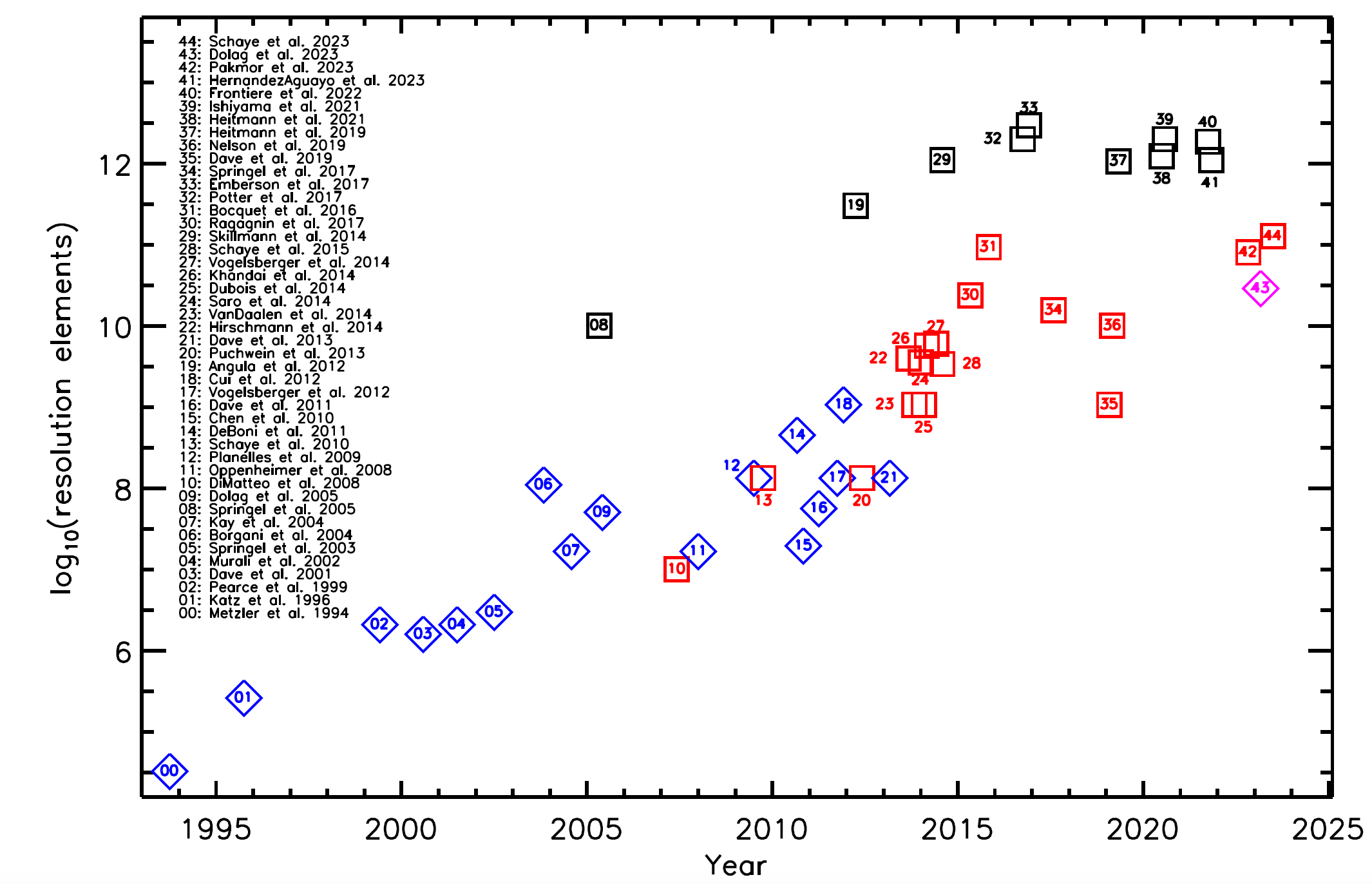
得益于计算能力的提升和数值方法的进步,过去几十年中可用于此类模拟的分辨率单元¹数量急剧增长,如Fig. 1所示。值得注意的是,迄今为止最大规模的流体动力学模拟(如 Magneticum² Box0/mr[5]
和 FLAMINGO³ L2p8_m9[6]
)在整个宇宙演化历程中追踪了超过 $2 \times 10^{11}$ 个粒子(包括 DM、气体、恒星和 BH 粒子)。
Thanks to the improved computing power and advancements in numerical methods, the number of resolution elements¹ which can be used in such simulations has increased dramatically over the last decades, as shown in Fig. 1. Note that the largest, hydrodynamical simulations up to date (e.g. Magneticum² Box0/mr[5]
and FLAMINGO³ L2p8_m9[6]
) followed a total number of more than 2×10¹¹ particles (e.g., DM, gas, stars and BH particles) across the entire evolution of the Universe.
本章将回顾描述流体动力学的基本数值方法,并讨论在宇宙学流体动力学模拟中纳入基本天体物理过程的主要途径(见视频3,第xiii页)。磁场和高能粒子等进一步的成分需要对其注入过程和演化进行额外建模,因此必须与流体动力学自洽耦合——这些内容在关于星系团的章节中有更详细的描述。
In this chapter, we will review the basic numerical methods which are used to describe the hydrodynamics, and discuss the main approaches adopted to incorporate the fundamental astrophysical processes in the context of cosmological hydrodynamical simulations (see Video 3, page xiii). Further components like magnetic fields and high-energy particles need additional modelling of their injection processes and evolution. Therefore, they must be self-consistently coupled with hydrodynamics and are described in more detail in 星系团章节.
系列导航
← 上一篇:Chapter 3 封面与摘要
→ 下一篇:§3.2 流体动力学与数值方法
评论