Adaptive mesh refinement
为拓宽数值格式的动力学范围,多种网格程序已采用网格细化策略(例如 ART、RAMSES、ENZO 和 FLASH)。多数情况下采用简单的密度(即每个网格的质量)判据:若某网格内的质量超过阈值
$m \equiv \rho \, \Delta x^3 > m_{min}$,
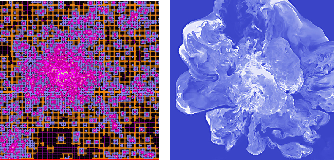
则将该网格分割为多个(例如八个)子网格,并将内部属性从原网格插值到新子网格上。这确保了引力质量(即引力源)在计算域内均匀分布。如此一来,底层网格便以准拉格朗日方式跟随质量流演化,如 Fig. 4 左图所示,该图展示了宇宙学模拟中细化网格的典型结构。
To widen the dynamical range of the numerical schemes, mesh refinement strategies have been applied in several grid codes (e.g., ART, RAMSES, ENZO, and FLASH). In most of the cases, a simple density (e.g., mass per cell) criterion is used. If the mass within one cell exceeds a certain threshold,
$m \equiv \rho \, \Delta x^3 > m_{min}$,
the cell is divided in multiple (e.g., eight) sub-cells and the internal properties are interpolated from the original cell onto the new sub-cells. This ensures that the gravitational mass (e.g., the source of gravity) is homogeneously distributed within the computational domain. In this way, the underlying grid evolves in a quasi-Lagrangian fashion following the mass flow, as illustrated in the left panel of Fig. 4, which shows the typical structure of the refinement grid in a cosmological simulation.
基于速度判据的其他细化策略也常被采用 [75]
,[76]
,用于研究星系团中的激波与湍流。
将前述判据扩展,额外对速度跳变进行细化,便可在整个宇宙结构中以前所未有的高空间分辨率追踪湍流和激波的形成,如 Fig. 4 右图所示。
为高精度、高准确度地追踪湍流级串,可额外使用次尺度湍流模型来初始化细化网格上的速度:这可防止湍流级串受到抑制 [77]
。
Other refinement strategies based on velocity criteria are often used [75]
,[76]
to study shocks and turbulence in galaxy clusters.
By extending the aforementioned criteria to additionally refining on velocity jumps, the formation of turbulence and shocks can be followed with unprecedented high spatial resolution throughout the cosmic structures, as shown in the right part of Fig. 4.
In order to follow the turbulent cascade with high precision and accuracy, sub-scale turbulence models can additionally be used to initialize the velocities on the refined cells: this prevents the turbulent cascade from being suppressed [77]
.
评论