Code comparison in galaxy and cluster simulations
前文所述的欧拉和拉格朗日方法,在理论上应用于同一问题时应给出相同的结果。为验证代码能否正确积分流体力学方程组,通常会用已知解析解的问题来测试。常见的测试问题包括激波管或球对称坍缩问题。
The Eulerian and Lagrangian approaches described in the previous sections are theoretically supposed to provide the same results when applied to the same problem. To verify that codes succeed at correctly integrating the set of hydrodynamical equations, they are usually tested against problems whose solution is known analytically. In practice, these test problems are shock tubes or spherical collapse problems.
不过,理想化的流体动力学测试——例如多相流体的相互作用 [109]
——通常会揭示不同方法所得结果之间的根本差异。造成这些差异的原因可能是基本方程的表述形式(例如经典SPH中不存在混合)、离散化方式(例如SPH表述中的体积偏差),或是数值误差的影响(例如网格代码中因重构误差而导致的平移不变性偏离)。
However, idealized hydrodynamical tests like the interaction of multi-phase fluids [109]
often reveal fundamental differences among results obtained with different methods. Such differences can be driven by the formulation of the underlying fundamental equations (like no mixing in classical SPH), by the discretization (like the volume bias in SPH formulations) or they can be due to the influence of numerical errors (like the departure of translation invariance in grid codes due to errors in the reconstruction).
在宇宙学中,具有已知解析解的问题并不现实;因此,一个有意义的测试是比较不同代码在标准设置下模拟宇宙结构形成时给出的结果。例如,[110]
比较了GADGET(基于SPH)和ENZO(基于网格)代码所预测的星际介质热力学性质。另一例网格代码与SPH代码之间的对比见 [111]
。
In cosmology, problems with known analytical solutions are impractical: as a consequence, a meaningful test is represented by comparing the results provided by different codes when they simulate the formation of cosmic structures in a standard set-up. As an example, [110]
compares the thermodynamical properties of the IGM predicted by the GADGET (SPH-based) and ENZO (grid-based) codes. Another example of a comparison between grid-based and SPH-based codes can be found in [111]
.
因此,对模拟星系或星系团形成与演化的流体动力学代码进行详细比较,是一项极其重要的测试。一项开创性的对比工作来自所谓的Santa Barbara星系团对比项目[112]
。在该项目中,12个不同的小组各自使用基于SPH技术(七个小组)或网格技术(五个小组)的代码,从相同的初始条件出发,对星系团进行了非辐射模拟。
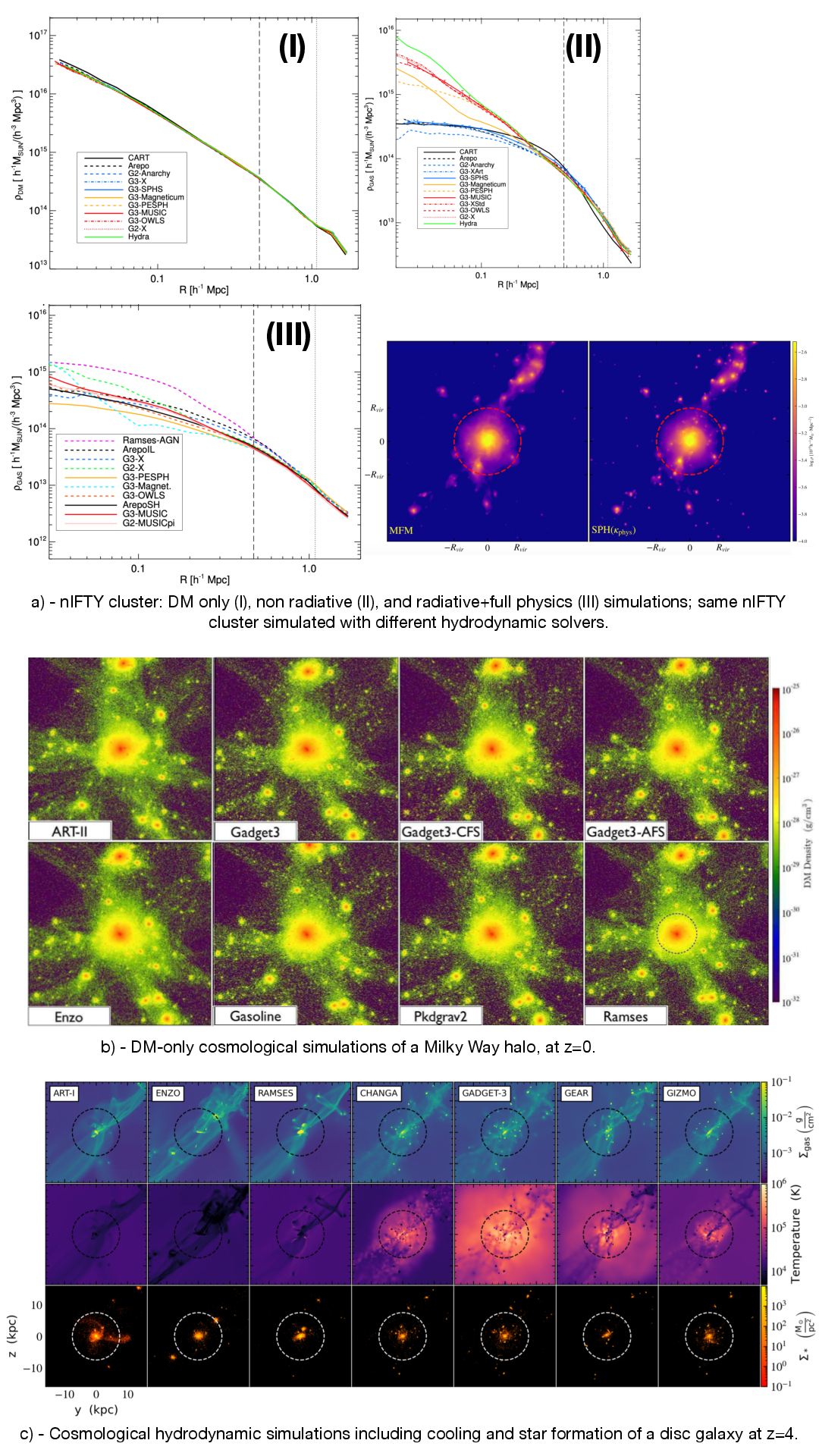
A detailed comparison of hydrodynamical codes which simulate the formation and evolution of a galaxy or of a galaxy cluster is therefore an extremely important test. A pioneering comparison was performed within the so-called Santa Barbara Cluster Comparison Project [112]
. Here, 12 different groups, each using a code either based on the SPH technique (seven groups) or on the grid technique (five groups), performed a non-radiative simulation of a galaxy cluster from the same initial conditions.
一个更新的对比项目——所谓的nIFTy星系团模拟 [113]
——还纳入了现代SPH实现以及移动网格代码AREPO。两项研究在气体性质的很大范围内都取得了一致的结果,例如密度、温度和熵轮廓,如Fig. 8所示。两项研究均发现,在轮廓的内区,网格代码与经典粒子代码之间差异显著更大。然而,正如[113]
所示,包含显式混合处理的粒子代码产生的结果与网格代码的结果非常相似。
A more recent comparison project, the so-called nIFTy galaxy cluster simulations [113]
, also involved modern SPH implementations as well as the moving mesh code AREPO.
A similar agreement over large ranges was obtained for many of the gas properties in both studies, like the density, temperature and entropy profiles, as shown in Fig. 8.
Both studies found significantly larger differences between mesh-based codes and classical particle-based codes to be present for the inner part of the profiles. However, as shown in [113]
, particle-based codes which include an explicit treatment of mixing produce results very similar to grid-based codes.
值得指出,一旦纳入了额外的物理过程——如恒星形成和AGN反馈,各种数值方法所得结果的差异便不再源于流体动力学求解器本身的区别;它们更多取决于模拟这些附加过程时所采用的数值方案的具体细节[116]
。
It is worth mentioning that as soon as additional physics like star formation and AGN feedback is included, the discrepancies in the results obtained by the various numerical methods are no longer driven by differences which can be ascribed to the hydrodynamical solvers: they are rather due to the details of the numerical prescriptions adopted to model these additional processes [116]
.
评论