Gas cooling
热气体冷却出现在方程equation:firstlaw的右端,同时也出现在描述亚网格模型中可能存在的不同气体相之间质量与能量流动的方程中。
Hot gas cooling enters the right-hand side of equation equation:firstlaw, as well as the equations describing mass and energy flows among different gas phases which may be present in sub-resolution models.
在宇宙学模拟中,关注的重点通常是维里温度超过$\sim 10^4$ K的结构。冷却函数$\Lambda(u,\rho)$标准实现中的常见假设是气体为光学薄且处于电离平衡。
通常还假设三体冷却过程不重要,从而将处理限定在二体过程。对于具有H和He原初组分的等离子体,这些过程包括:H$^0$和He$^+$的碰撞激发,H$^0$、He$^0$和He$^{+}$的碰撞电离,H$^+$、He$^+$和He$^{++}$的标准复合,He$^+$的双电子复合,以及自由-自由发射(轫致辐射)。
碰撞电离和复合速率仅依赖于温度。因此,若不存在电离背景辐射,所得速率方程可解析求解,由此得到的冷却函数$\Lambda(u)/\rho^2$如Fig. 9左图所示。
反之,若存在电离背景辐射,速率方程则可通过迭代求解。注意,对于典型的宇宙学辐射背景(例如,来自恒星形成星系和类星体的紫外背景,见[118]
、[119]
、[120]
、[121]
),冷却函数的形状可能发生显著改变,特别是在低密度下。更详细的讨论见星系形成章节和[17]
。
In cosmological simulations, the focus is usually on structures whose virial temperature exceeds $\sim 10^4$ K. Common assumptions in standard implementations of the cooling function $\Lambda(u,\rho)$ is that the gas is optically thin and in ionization equilibrium.
It is also usually assumed that three-body cooling processes are unimportant so as to restrict the treatment to two-body processes. For a plasma with primordial composition of H and He, these processes are: collisional excitation of H$^0$ and He$^+$, collisional ionization of H$^0$, He$^0$, and He$^{+}$, standard recombination of H$^+$, He$^+$, and He$^{++}$, dielectric recombination of He$^+$, and free--free emission (bremsstrahlung).
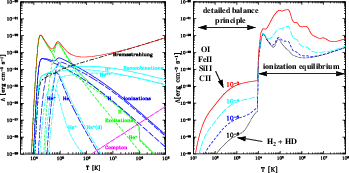
The collisional ionization and recombination rates depend only on temperature. Therefore, should an ionizing background radiation be absent, the resulting rate equations can be solved analytically. This leads to a cooling function $\Lambda(u)/\rho^2$ as illustrated in the left panel of Fig. 9.
On the other hand, in the presence of ionizing background radiation, the rate equations can be solved iteratively. Note that for a typical cosmological radiation background (e.g., UV background from star-forming galaxies and quasars, see [118]
,[119]
,[120]
,[121]
), the shape of the cooling function can be significantly altered, especially at low densities. For a more detailed discussion, see, for example, 星系形成章节 and [17]
.
此外,金属的存在将使气体冷却的途径大大增多。由于此时计算冷却函数的计算量极大,宇宙学模拟通常依赖预计算的表格化冷却函数。例如,Fig. 9右图显示了来自[123]
的表格化冷却函数,温度在$10^5$ K以上,对应不同的气体金属丰度,同时保持不同金属元素的比例固定为太阳值。
如今模拟中常采用的一种改进方法是使用`Cloudy`程序([124]
),它允许用户针对不同的紫外强度网格以及各种不同的化学元素,分别表格化冷却和加热率。通过这种方式,冷却率可针对任意化学
%
组分自洽地计算。
注意,几乎所有的实现都将上述速率方程(乃至气体的冷却)作为与流体动力学处理解耦的"子时间步"问题来求解,这相当于假设密度在整个时间步内固定不变。
此外,出于实际原因,底层流体动力学模拟的时间步通常既不受冷却时标的控制,也与冷却时标无关。这些近似所引入的不确定性尚未得到深入探索,显然为未来的研究留下了空间。
Additionally, the presence of metals will drastically increase the number of possible processes by which gas can cool. As it becomes computationally very demanding to calculate the cooling function in this case, cosmological simulations usually rely on a pre-computed, tabulated cooling function. As an example, the right panel of Fig. 9 shows the tabulated cooling function from [123]
, for temperatures above $10^5$ K, for different metallicities of the gas, keeping the ratios of different metal species fixed to solar values.
A refinement that is nowadays often exploited in simulations consists in using the `Cloudy` code ([124]
), which allows users to tabulate the cooling and heating rates, individually for a grid of UV intensities and for various different chemical elements. In this way, cooling rates are self-consistently calculated for arbitrary chemical
%
compositions.
Note that almost all the implementations solve the above rate equations (and therefore the cooling of the gas) as a ``subtime step'' problem, decoupled from the hydrodynamical treatment. This translates in assuming that the density is fixed across the time step.
Furthermore, the time step of the underlying hydrodynamical simulation is in general, for practical reasons, not controlled by nor related to the cooling time scale. The resulting uncertainties introduced by these approximations have not yet been deeply explored and clearly leave room for future investigations.
对于维里温度低于$10^4$ K的暗晕中第一批天体的形成,电离平衡假设不再成立。在这种情况下,必须考虑非平衡反应,即在宇宙学演化过程中求解每种物质各能级的平衡方程。
在没有金属的情况下,主要的冷却剂是H$_2$和H$_2^+$分子(见[125]
)。HD分子也可发挥重要作用。当存在金属时,可用的反应更多,其中一些可对$10^4$ K以下的冷却函数产生显著贡献。这一效应在Fig. 9右图中$T<10^4$ K的部分清晰可见。更多细节见星系形成章节、参考文献[126]
、[122]
及其中的参考文献。
For the formation of the first objects in halos with virial temperatures below $10^4$ K, the assumption of ionization equilibrium no longer holds. In this case, the non-equilibrium reactions have to be considered, by solving the balance equations for the individual levels of each species during the cosmological evolution.
In the absence of metals, the main coolants are H$_2$ and H$_2^+$ molecules (see [125]
). HD molecules can also play a significant role. When metals are present, many more reactions are available and some of these can contribute significantly to the cooling function below $10^4$ K. This effect is clearly visible in the right panel of Fig. 9 for $T<10^4$ K. For more details, see 星系形成章节, Refs. [126]
,[122]
, and references therein.
评论