Stellar feedback
恒星反馈是结构形成宇宙学模拟的关键组成部分。在其众多关键作用中,它可防止高红移处的过度冷却,在星际介质中分配能量,将金属驱出恒星形成区,并触发星系外流,从而确保形成中的星系与其周围星系周介质之间的持续相互作用。
鉴于驱动和发射星系风的pc尺度物理过程尚不完全清楚,且远未达到能在宇宙学模拟中直接实现的程度,这些模拟不得不借助唯象预设来捕捉星系外流的效应。从驱动外流并支配其运动学的能量来源来看,有两种常见途径:星系风可以是能量驱动的,也可以是动量驱动的。关于这两种情景的细节,建议读者参考星系形成章节,此文为本小节的具体主题提供了补充信息。
本概述远非完备:更深入的讨论可见于[213]
、[155]
、[214]
、[215]
等文献。
Stellar feedback is a key component of cosmological simulations of structure formation. Among its many crucial roles, it prevents overcooling at high redshift, distributes energy in the ISM, drives metals out of the star formation sites, and triggers galactic outflows, which guarantee a continuous interaction between the forming galaxy and its surrounding CGM.
Since the understanding of the pc-scale physics responsible for launching and driving winds is still partial and however far from being implemented directly in cosmological simulations, these simulations have to resort to phenomenological prescriptions to capture the effects of galactic outflows. As for the sources of energy that power outflows and govern their kinematic, there are two commonly pursued approaches: winds can be either energy-driven or momentum-driven. For details about these two possible scenarios, we refer the reader to 星系形成章节, which provides complementary information on the specific topic of this sub-section.
This outline is far from being complete: deeper insight can be gained e.g. from [213]
,[155]
,[214]
,[215]
.
宇宙学模拟中已提出多种恒星反馈方案:星际介质中超新星爆发的能量注入,其数值描述方式确实对最终结果有强烈影响。不同的亚分辨率模型能否有效捕捉反馈能量注入,其可靠性究竟如何,目前仍存争议。
A variety of stellar feedback schemes has been proposed in cosmological simulations: the numerical description of the energy injection from SN explosions in the ISM has indeed a strong impact on final results. How reliable different sub-resolution models are in capturing an effective description of feedback energy injection is still debated.
超新星能量可由恒星形成气体元素以热能或动能形式分配至周围环境。将反馈能量以热形式注入——如[17]
的先驱模型——其局限在于:反馈通常无法将能量有效输运至远离释放区域之处。提供能量的气体元素,其周围温度通常为$\sim 10^5$ K,密度足够高,几乎立即辐射能量,因而冷却时标很短。因此,反馈无法有效抵消冷却,也难以防止过度的恒星形成。为克服这一弱点,[216]
提出了随机热反馈模型,该模型将接收热反馈能量的气体加热到足够高的温度,以保证反馈有效。具体来说,上述模型假设超新星爆发释放的热能通过一个选择判据注入周围介质:接受反馈的气体粒子必须加热到一个阈值温度,该阈值温度是模型的一个参数(其值通常接近$10^7$ K)。这样的温度升高确保受热粒子的冷却时标长于其声波穿越时标,从而使受热气体在辐射掉全部能量之前能够有效离开恒星形成区。值得指出,在这个模型中恒星反馈实际上是通过热通道实现的:然而,其有效结果是星系风,因为热能转化为动量,进而产生外流。例如,EAGLE和FLAMINGO模拟便采用了这种恒星反馈模型[41]
、[6]
。
SN energy can be distributed by star-forming gas elements to the surroundings in the form of thermal or kinetic energy. Injecting feedback energy as thermal, as in the pioneer model of [17]
, may have the limitation that the feedback usually does not result effective in driving energy far from regions where it is released. Gas elements surrounding those that provide energy have a typical temperature of $\sim 10^5$ K and density high enough to radiate energy almost immediately, their cooling time being short. As a result, feedback is not effective in counterbalancing cooling and in preventing excessive star formation. To overcome this weakness, a stochastic thermal feedback model has been proposed [216]
, where gas receiving thermal feedback energy is heated up to a temperature high enough to guarantee the effectiveness of feedback. Specifically, the aforementioned model assumes that thermal energy released by SN explosions is injected in the surrounding medium using a selection criterion: the gas particles that experience feedback have to be heated up to a threshold temperature, which is a parameter of the model (whose value is usually close to $10^7$ K). Such a temperature increase ensures that the cooling time of a heated particle is longer than its sound-crossing time, so that heated gas can effectively leave the star formation site before it radiates all the energy away. It is worth noting that stellar feedback is actually implemented as a thermal channel in this model: however, the effective outcome is a galactic wind, because thermal energy is converted into momentum and hence outflows originate. This model for stellar feedback is for instance adopted by the EAGLE and FLAMINGO simulations [41]
,[6]
.
另一种方式则是将恒星反馈能量以动能形式提供,用于加速周围气体元素(例如[131]
、[217]
),将它们从其原始位置踢出。它们最终可以热化并辐射掉能量,但按其构造,这比热情景要晚。为增强动能反馈方案的有效性,接收能量并采样星系外流的粒子(通常称为{\it{风粒子}})通常与流体动力学相互作用解耦:这样,它们就不会在获得能量后很快被阻止和热化。
Otherwise, stellar feedback energy is provided in the form of kinetic energy and used to boost the velocity of surrounding gas elements (e.g. [131]
,[217]
), which are kicked from their original position. They can eventually thermalise and radiate energy away, but later than in the thermal scenario by construction. To enforce the effectiveness of kinetic feedback schemes, particles that receive energy and sample galactic outflows (usually referred to as {\it{wind particels}}) are often decoupled from hydrodynamic interactions: in this way, they are prevented from being halted and from thermalising energy soon after they have been provided with.
另一种恒星反馈模型是所谓的冲击波反馈[218]
、[219]
。在该方案中,符合条件的粒子被赋予热反馈能量,但在短时间内(通常为数十Myr)被阻止冷却。这一预设的物理动机源于星际介质中超新星遗迹的演化[220]
。当一颗爆发的超新星驱动冲击波时,它首先经历自由膨胀阶段,随后进入绝热阶段(Sedov-Taylor阶段),其中辐射损失可以忽略,然后才进入辐射阶段。暂时禁用冷却模拟了未分辨的绝热阶段,其持续时间估计约为$30$ Myr;此后,气体被允许再次冷却。另一种解释是,关闭冷却可理解为超新星爆发释放的能量在未分辨尺度上产生湍流,并在数十Myr内部分耗散,从而阻碍气体冷却[221]
、[222]
。在宇宙学模拟中实现时,这种反馈预设能够有效避免过度的恒星形成,并成功产生一个双相星际介质,其气体成分在局部不处于压力平衡。
An alternative stellar feedback model is represented by the so-called blast-wave feedback [218]
,[219]
. Within this scheme, eligible particles are provided with thermal feedback energy, but are then prevented from cooling for a short period of time (typically few tens of Myr). The physical motivation
behind this prescription stems from the evolution of a SN remnant in the ISM [220]
. As soon as an exploding SN drives a blast wave, this undergoes a first phase of free expansion, followed by an adiabatic stage (the Sedov-Taylor phase) where radiative losses are negligible, before entering the radiative phase. Temporarily disabling cooling mimics the unresolved adiabatic phase, whose duration is estimated to be of order $30$ Myr; afterwards, gas is allowed to cool again. Alternatively, the switch off of cooling can be explained by assuming that the energy released by SN explosions generates turbulence at unresolved scales and is partially dissipated over few tens of Myr, thus hindering gas cooling [221]
,[222]
. When implemented in cosmological simulations, this feedback prescription results effective in avoiding excessive star formation and also succeeds at producing a two-phase ISM, whose gas components are not in pressure equilibrium locally.
大质量恒星影响星系气体储库的反馈过程不仅源于超新星爆发后的能量沉积和动量注入,还源于大质量恒星爆发前的电离效应(通常称为早期恒星反馈;例如[179]
)以及星风(例如[223]
、[224]
)。
具体来说,[179]
提出的早期恒星反馈代表了一种UV电离源,可提高周围气体的温度,并提供加热和压力支撑。这一反馈通道对恒星形成区的星际介质进行预处理,有助于超新星有效调节恒星形成。在他们的模拟中,[179]
展示了早期恒星反馈如何帮助抑制高红移处的恒星形成(另见NIHAO模拟以了解早期恒星反馈如何运作[137]
、[225]
)。
Feedback processes through which massive stars can affect the reservoir of gas of a galaxy stem not only from the energy deposition and momentum injection following SN explosions, but also from the ionizing effect that massive stars have before exploding (usually referred to as early stellar feedback; e.g. [179]
) and from stellar winds (e.g. [223]
,[224]
).
Specifically, the early stellar feedback by [179]
represents a UV ionization source, that increases the surrounding gas temperature and supplies heating and pressure support. This feedback channel pre-processes the star-forming ISM and facilitates the effectiveness of SNe at regulating star formation. In their simulations, [179]
show how early stellar feedback helps in suppressing SF at high z (see also the NIHAO simulations to appreciate how early stellar feedback operates [137]
,[225]
).
此外,SNe II释放的能量预期不会在宇宙时间中或在所有恒星形成区中保持不变,理论模型预测,在几乎原始或弱增丰环境中爆发的超新星会为星际介质提供更大量的恒星反馈能量。
根据恒星形成区星际介质的物理性质来区分恒星反馈结果的想法已在宇宙学模拟中得到探索,并提出了一些有效的预设。其基本思想是采用非恒定值的恒星反馈效率(即每个超新星提供的能量中,实际作为反馈能量耦合到周围气体的比例)。
In addition, the energy released by SNe II is not expected to be constant across cosmic time nor in all the star-forming regions, and theoretical models predict that SNe exploding in almost pristine or weakly enriched environments provide the ISM with a larger amount of stellar feedback energy.
The idea of differentiating the outcome of stellar feedback according to the physical properties of the star-forming ISM has been already pursued in cosmological simulations, and a few effective prescriptions have been proposed. The basic idea consists in adopting a non-constant value of the stellar feedback efficiency (i.e. the fraction of energy provided by each SN that is actually coupled to the surrounding gas as feedback energy).
EAGLE模拟引入了一个依赖金属丰度和密度的恒星反馈效率[41]
、[226]
。其中,上述效率随气体金属丰度增加而降低,随气体密度增加而升高。采用这种参数化有两方面原因:$i)$ 辐射损失预期随金属丰度增加而增加;$ii)$ 高密度恒星形成区中的能量损失可能使恒星反馈效率过低,必须加以补偿。
由于较高红移处气体金属丰度较低,而恒星形成区星际介质通常达到更高密度,这样的预设会产生一个依赖红移的恒星反馈效率。后者在渐近值之间变化,这些值是模型的参数,经调谐以再现低红移观测量,例如星系恒星质量函数。
A metallicity- and density-dependent stellar feedback efficiency has been introduced in the EAGLE simulations [41]
,[226]
. There, the aforementioned efficiency decreases with gas metallicity while increasing with gas density. The adoption of a similar parametrization has a twofold reason: $i)$ radiative losses are expected to increase with increasing metallicity; $ii)$ energy losses in high-density, star-forming regions can make the stellar feedback too inefficient, and have to be counterbalanced.
Being the gas metallicity lower at higher redshifts, when also higher densities are usually reached in the star-forming ISM, such a prescription yields a redshift-dependent stellar feeback efficiency. The latter ranges between asymptotic values, which are parameters of the model tuned to reproduce low-redshift observables, e.g. the galaxy stellar mass function.
Illustris-TNG模拟[139]
也采用了类似的参数化。
他们假设恒星形成分辨单元可用的星系风能量依赖金属丰度。SNe II释放的反馈能量范围为$(0.9 - 3.6) \times 10^{51}$ erg,具体取决于它们预期爆发的恒星形成气体细胞的金属丰度——金属丰度越低,能量预算越大。[139]
论证了依赖金属丰度的恒星反馈能量调制对恒星-暗晕质量关系和星系恒星质量函数均有影响,最终结果强烈依赖于参数的调谐。他们表明,$z=0$处一个$\sim 10^{12}$ M$_{ \odot}$暗晕的恒星质量可变化多达$\sim 2$倍。
A similar parametrization is adopted in the Illustris-TNG simulation [139]
, too.
They assume that the wind energy available to a star-forming resolution element is metallicity-dependent. SNe II release indeed a feedback energy which spans the range $(0.9 - 3.6) \times 10^{51}$ erg, according to the metallicity of the star-forming gas cell in which they are expected to explode -- the lower the metallicity, the larger the energy budget. [139]
demonstrate how the metallicity-dependent stellar feedback energy modulation has an impact both on the stellar-to-halo mass relation and on the galaxy stellar mass function, final results strongly depending on the tuning of the parameters. They show that the stellar mass of a $\sim 10^{12}$ M$_{ \odot}$ halo at $z=0$ can vary by up to a factor of $\sim 2$.
在更高复杂层面上,尽管是针对较小体积的模拟,[227]
首次在宇宙学模拟中模拟了不同星族的同时演化。在他们的运行中,恒星反馈依赖于底层气体金属丰度和星族,注入的能量和假定的恒星产额取决于星族III与星族II的状态,即对不稳定性超新星与超新星。有趣的是,[228]
包含了自洽耦合辐射转移的效应,并得出结论:来自大质量星族III恒星的辐射反馈可以为原始环境中的强大反馈提供一个可行的解释。
At a higher level of complexity, though in simulations targeting smaller volumes, [227]
first modelled the simultaneous evolution of different stellar populations in cosmological simulations. Their runs feature stellar feedback dependent on the underlying gas metallicity and stellar population, where the injected energy and the assumed stellar yields depend on Population III versus Population II regimes, i.e. pair-instability SNe versus SNe. Interestingly, [228]
included the effect of self-consistently coupled radiative transfer, concluding that radiative feedback from massive Population III stars could be a viable justification for powerful feedback in pristine environments.
受上述发现和理论研究(例如[229]
、[230]
的综述)的推动——这些研究表明星族III恒星的极超新星和SNe II释放的能量可能比当今宇宙高出$\sim10$倍以上——[160]
引入了一种有效的低金属丰度反馈。在这种依赖金属丰度的恒星反馈实现中,他们考虑了弱增丰环境中极超新星和SNe II爆发的影响,具体做法是增强在几乎原始的周围介质(即平均金属丰度低于阈值的星际介质)中爆发的超新星所释放的能量。
Motivated by the aforementioned findings and by theoretical studies (e.g., [229]
,[230]
for reviews) that suggest that hypernovae and SNe II of Population III stars can release energy higher than in the present-day Universe by more than a factor of $\sim10$, [160]
introduced an effective low-metallicity feedback. In this implementation of metallicity-dependent stellar feedback, they accounted for the effect of the explosion of hypernovae and SNe II in weakly-enriched environments, by boosting the energy released by SNe exploding in an almost pristine ambient medium (i.e. in an ISM with average metallicity below a threshold).
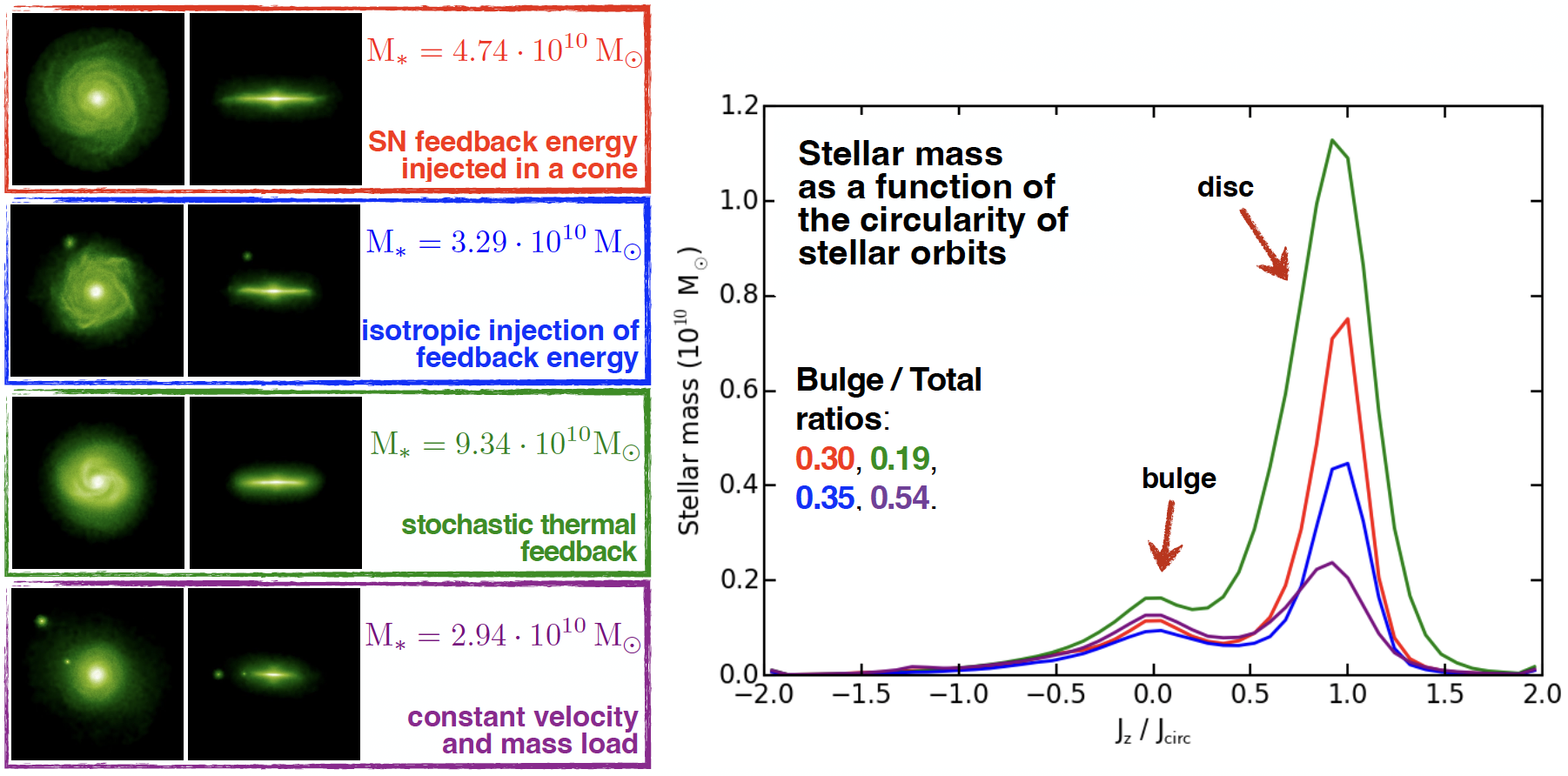
描述同一物理过程(在此特指恒星反馈和超新星触发的星系外流)的不同亚网格预设对最终结果的影响是惊人的,尽管常被忽视。
[135]
通过对一系列银河系大小暗晕的宇宙学缩放模拟,研究了恒星反馈建模对盘状星系形成和演化的影响。他们展示了模拟星系的一般性质对恒星反馈触发外流实现方式的敏感程度,比较了采用不同最先进恒星反馈模型所得的结果(见Fig. 10)。
我们建议读者参考[114]
、[115]
以了解更广泛的比较项目,即Aquila和Agora比较项目(另见Fig. 8)。
有趣的是,[215]
也展示了在EAGLE和Illustris-TNG模拟中对恒星反馈效率做出不同假设,如何反映在预测的星系恒星质量函数上(另见[226]
、[139]
)。
The impact of different sub-grid prescriptions accounting for the same physical process (stellar feedback and SN-triggered galactic outflows in this specific case) on final results is striking, though often overlooked.
[135]
investigate the impact of stellar feedback modelling on the formation and evolution of a disc galaxy, by performing a suite of cosmological zoom-in simulations of a Milky Way-size halo. They show how sensitive the general properties of the simulated galaxy are to the way in which stellar feedback triggered outflows are implemented, comparing results obtained by adopting different state-of-the-art stellar feedback models (see Fig. 10).
We refer the reader to [114]
,[115]
for more extended comparison campaigns, i.e. the Aquila and the Agora comparison projects (see also Fig. 8).
Interestingly, [215]
also show how making different assumptions as for the stellar feedback efficiencies in the EAGLE and Illustris-TNG simulations reflects on the predicted galaxy stellar mass functions (see also [226]
,[139]
).
评论