AGN feedback in state-of-the-art cosmological simulations
观测使我们得以理解AGN反馈如何以不同的机制(如膨胀气泡或发射外流)和不同的表现形式,在各种系统中发展。此外,这是一个反复发生的过程,每一次AGN爆发都在系统中留下清晰的印记。星系内部及周围多相气体的存在,进一步增加了AGN反馈理解和建模的复杂性。多波长观测揭示星系中存在跨越广泛密度、温度和电离状态范围的气体。多相气体不仅存在于富含冷气体的旋涡星系中,也存在于椭圆星系以及星系群和星系团的最内部区域——这些环境以X射线辐射的热气体为主导。
Observations allow us to appreciate how AGN feedback develops with different mechanisms (for instance inflating bubbles or launching outflows), with different appearances, in a variety of systems.
Besides, it is a recurrent process, with each AGN burst leaving a clear signature in the system.
Additional evidence which adds complexity to the comprehension and modelling of AGN feedback is the presence of multiphase gas in and around galaxies.
Multiwavelength observations reveal the presence of gas spanning a wide range of densities, temperatures, and ionisation states in galaxies. Multiphase gas is present not only in spiral galaxies, which are systems rich in cold gas, but also in ellipticals and in the innermost regions of galaxy groups and clusters, which are environments known to be dominated by X-ray emitting, hot gas.
观测([276]
、[277]
等文献)也为黑洞吸积和反馈的不同状态提供了证据。在简化框架下,AGN活动通过(至少)两个不同的阶段运作:辐射模式或类星体模式,以及动能模式或射电模式(综述见[278]
)。射电模式的特征是大型射电喷流产生热的X射线空洞,而在类星体模式下,辐射由吸积盘主导,反馈能量主要以辐射形式耗散。在理论上,这一区别可通过将AGN反馈描述为两个分量——辐射和力学外流——加以建模([273]
;[279]
在其模型中考虑了黑洞吸积的三种不同状态)。在这些模型中,与每个分量相关的能量大小取决于Eddington比$f_{Edd}$(见§3.15)。上述两种简单理论模型不仅得到观测支持,还获得其他独立解析模型的佐证([280]
及其参考文献),这些模型展示了如何将不同的黑洞吸积率,与辐射效率的变化及向不同类型吸积盘的转变联系起来。此外,观测([281]
、[282]
)表明辐射效率不仅与黑洞吸积率相关,还与黑洞质量相关(另见[272]
)。
Observations ([276]
,[277]
among other works) also provide evidence for different regimes of BH accretion and feedback. In a simplified context, the AGN activity operates through (at least) two distinct phases: radiative or quasar mode, and kinetic or radio mode ([278]
for a review). The radio-mode is characterized by large radio jets generating hot X-ray cavities, whereas in the quasar-mode the emission is dominated by the accretion disc, and feedback energy is mainly radiated away. This distinction has been theoretically modelled [273]
by describing AGN feedback with two components: radiation and mechanical outflows ([279]
considered three different regimes for BH accretion in their model). In these models, the amount of energy associated with each component depends on the Eddington ratio $f_{Edd}$ (see §3.15).
Not only are simple theoretical models like the two aforementioned ones supported by observations, but they are also corroborated by other independent analytical models ([280]
and references therein), which showed how it is possible to associate different BH accretion rates to changes in the radiative efficiency and to transitions to different types of accretion discs.
In addition, observations [281]
,[282]
suggest that the radiative efficiency does not only correlates with the BH accretion rate, but also with the BH mass (see also [272]
).
然而,双模式AGN反馈仅是对平滑过渡的一种近似——这种过渡已为观测(如[276]
、[283]
)和理论(如[284]
、[285]
、[280]
、[286]
)所预期。实际上,现实比上述简化框架更为复杂,AGN反馈通过多种模式运作,且这些模式常常同时发生。主要的AGN反馈机制包括:预防模式(preventive/preventative mode),即反馈阻止气体吸积或有效冷却;抛射模式(ejective mode),即从恒星形成发生的最内层区域移除气体;AGN反馈可通过湍流和星际介质加热来抑制恒星形成效率;它也可通过对尘埃的辐射压来清除黑洞附近的气体;或者AGN可以以维持模式(maintenance mode)运作,使业已熄灭的系统保持宁静。除了上述所有黑洞反馈为负反馈(即总体上抑制恒星形成率)的模式外,AGN反馈也可以是正反馈,它主要通过星际介质超压(ISM overpressurization),在特定时间段内局部增强恒星形成效率。要解决整体的AGN反馈问题,必须考虑不同的状态,始终牢记AGN及其宿主星系嵌在暗物质晕中。
However, a two-mode AGN feedback is only an approximation to the smooth transition which is observed (e.g., [276]
,[283]
) and also theoretically expected (e.g., [284]
,[285]
,[280]
,[286]
).
Reality is in fact more complex than the aforementioned simplified frameworks, and AGN feedback operates through a variety of modes, which often occur simultaneously. Among the main AGN feedback mechanisms, there is the preventive (or preventative) mode, where feedback prevents the gas from being accreted or from effectively cooling; the ejective mode, in which gas is removed from the innermost regions of forming structures where SF occurs; AGN feedback can suppress the SF efficiency, mainly via turbulence and ISM heating; it can operate via radiation pressure on dust, which clears out gas from the BH vicinity; or AGN can act in the maintenance mode, by keeping quiescent an already quenched system.
Besides all the aforementioned modes in which BH feedback is negative, i.e. it produces an overall suppression of the SFR, AGN feedback can also be positive and locally enhance the SF efficiency for a given period of time, mainly via ISM overpressurization.
Different regimes have to be accounted for to address the overall AGN feedback problem, always considering that
AGN and their host galaxies are embedded in a DM halo.
AGN的另一个关键特征是其发展跨越很大的动力学尺度范围,并影响具有不同密度和温度范围的气体演化。这可以从核区尺度一直延伸到星系团尺度,经由星际介质(ISM)、环星系介质(CGM)、星系群内介质和星系团内介质(ICM)。这种空间尺度的大范围对应于同等宽广的时间尺度范围(如[287]
)。
Another key characteristic of AGN is that it develops across a large dynamical range of scales, and that it impacts on the evolution of gas with a range of densities and temperatures. This can occur from nuclear scales to galaxy cluster scales, moving through the ISM, the CGM, the intra-group medium and the ICM.
This large range in spatial scales corresponds to an equivalently wide range in temporal scales (e.g., [287]
).
最先进的宇宙学模拟仍远未完全捕捉到这种复杂性。从[242]
、[241]
的开创性工作开始,研究者提出了许多AGN反馈建模方案,用以在宇宙学模拟中描述超大质量黑洞(SMBH)反馈。遵循上述两篇论文,许多模拟假设,以吸积率$\dot{M}_{\bullet}$吸积的SMBH,其单位时间内释放的AGN反馈能量可表示为:
State-of-the-art cosmological simulations are still far from fully capturing the complexity. Starting from the seminal works by [242]
,[241]
, a number of prescriptions for modelling AGN feedback have been conceived to account for SMBH feedback in cosmological simulations. Following the two aforementioned papers, many simulations assume that the AGN feedback energy that a SMBH accreting at a rate $\dot{M}_{\bullet}$ releases per unit time can be cast as:
$$
\dot{E} = \epsilon_f \epsilon_r \dot{M_\bullet} c^2,
其中$\epsilon_r$和$\epsilon_f$分别为辐射效率和反馈效率。
$$
where $\epsilon_r$ and $\epsilon_f$ are the radiative and the feedback efficiencies, respectively.
辐射效率$\epsilon_r$通常取恒定值$0.1$([241]
、[141]
),这对应于非旋转Schwarzschild黑洞上辐射有效吸积的平均值([288]
、[289]
、[290]
)。近期研究(如[142]
、[291]
)则引入了依赖黑洞自旋的$\epsilon_r$。
A constant value for the radiative efficiency $\epsilon_r$ is often used. It is often set to $0.1$ [241]
,[141]
, which corresponds to the mean value for the radiatively efficient accretion onto a non-spinning, Schwarzschild BH [288]
,[289]
,[290]
. Recent works (e.g., [142]
,[291]
) included a BH spin-dependent $\epsilon_r$.
反馈效率$\epsilon_{f}$量化的是:从黑洞辐射的能量中,实际耦合给周围气体的比例。宇宙学模拟中通常采用的数值范围为$\sim 10^{-4} - 0.2$(如[292]
、[293]
、[294]
、[35]
、[295]
、[139]
、[296]
)。该效率通常通过调谐来匹配黑洞-恒星质量关系的归一化([231]
、[238]
)。$\epsilon_{f}$的值可以是恒定的(如[241]
、[41]
),也可以取决于AGN模式。观测证据表明,以较低吸积率吸积的SMBH驱动更强的外流([273]
、[279]
、[297]
),基于此,[298]
引入了类星体模式与射电模式之间反馈效率的急剧转变(另见[299]
、[300]
、[35]
、[268]
、[141]
、[44]
)。即使在同一种(射电)模式内,$\epsilon_{f}$也可随ISM密度而变化([301]
、[139]
)。
The feedback efficiency $\epsilon_{f}$ quantifies the fraction of energy radiated from the BH which is actually coupled to the. Values commonly assumed in cosmological simulations span the range $\sim 10^{-4} - 0.2$ (e.g., [292]
,[293]
,[294]
,[35]
,[295]
,[139]
,[296]
). This efficiency is often tuned in order to match the normalisation of the BH to stellar mass relation [231]
,[238]
.
The value of $\epsilon_{f}$ can be either constant (e.g., [241]
,[41]
, or dependent on the AGN mode. Motivated by the observational evidence of more powerful outflows associated with SMBHs accreting at lower rate [273]
,[279]
,[297]
, [298]
introduced a steep transition of the feedback efficiency between quasar-mode and radio-mode, (see also [299]
,[300]
,[35]
,[268]
,[141]
,[44]
). Even within the same (radio) mode, $\epsilon_{f}$ can change according to the ISM density [301]
,[139]
.
AGN反馈能量可通过不同的数值方案沉积:既可以纯粹以热能或动能形式注入,也可以用于注入气泡,或根据(例如)黑洞吸积率的不同通道来分配。在多种可能的AGN反馈模型中,值得指出的是现代宇宙学模拟所采用的若干方案。
AGN feedback energy can be deposited by means of different numerical prescriptions: either purely in the form of thermal or kinetic energy, or it can be used to inject bubbles, or according to different channels depending on e.g., the BH accretion rate.
Among the several possible AGN feedback models, it is worth highlighting a number of schemes that modern cosmological simulations adopt.
遵循[242]
、[241]
的原始思想,AGN反馈能量可简单地以热形式注入:通过这种方式,黑洞将AGN反馈能量(公式feedback_energy_old)分配给邻近的分辨率单元,可能以核函数加权的方式进行。接收到的热能用于增加黑洞周围粒子或网格的内能,从而使其温度升高。虽然该简单方案总体有效,但往往效率不高,且未能成功复现目前在不同红移处可获得的各种观测结果。尽管如此,该方案仍在宇宙学模拟中广泛使用,通常仅用于描述类星体模式反馈,同时辅以针对较低黑洞吸积率的补充模型。例如,[268]
、[35]
、[141]
、[139]
、[142]
、[145]
在其模拟中均依赖该模型来描述类星体模式反馈。
Following the original idea of [242]
,[241]
, the AGN feedback energy can be simply dumped thermally: in this way, the BH distributes the AGN feedback energy (eq. feedback_energy_old) to nearby resolution elements, possibly in a kernel-weighted fashion. The thermal energy received is used to increase the internal energy of particles or cells surrounding the BH, which increase their temperature as a consequence. While being overall effective, this simple prescription often turns out to be inefficient and does not succeed at reproducing the variety of observations currently available at different redshift. Nonetheless, this prescription is still widely used in cosmological simulations, that often adopt it to describe the quasar-mode feedback only, along with a complementary model for lower BH accretion rates.
As an example, [268]
,[35]
,[141]
,[139]
,[142]
,[145]
rely on this model to describe the quasar-mode feedback in their simulations.
实际上,Magneticum和SLOW模拟套件采用双模式AGN反馈:对于高黑洞吸积率(即$f_{Edd} > 0.01$),SMBH经历类星体相并向周围释放热能。另一方面,它们通过热气泡的能量沉积来模拟射电模式反馈($f_{Edd} < 0.01$)(遵循[302]
、[299]
)。在这些模拟中,辐射效率和反馈效率是自由参数。具体而言,射电模式反馈中的$\epsilon_{f}$相比类星体相增大了4倍。有趣的是,在Magneticum模拟的一个子集中([272]
),他们探索了双模式AGN反馈的不同情景,以外流取代热气泡。然而,由于分辨率有限,后一种力学通道在数值上实现为热反馈。
Indeed, in the Magneticum and in the SLOW simulation suites, they assume a two-mode AGN feedback: for high BH accretion rates, i.e. $f_{Edd} > 0.01$, SMBHs experience a quasar phase and release thermal energy in the surrounding. On the other hand, they model the radio-mode feedback ($f_{Edd} < 0.01$) through energy deposition by hot bubbles (following [302]
,[299]
). In these simulations, radiative and feedback efficiencies are free parameters. Specifically, $\epsilon_{f}$ is increased by a factor of 4 during the radio-mode feedback with respect to the quasar phase.
Interestingly, in a subset of the Magneticum simulations [272]
, they explore a different scenario for a two-mode AGN feedback, where hot bubbles are replaced by outflows. However, due to the limited resolution, the latter mechanical channel is numerically implemented as thermal feedback.
虽然Illustris模拟([268]
、[40]
)以类似于Magneticum的方式实现AGN反馈(即$f_{Edd} > 0.05$时使用热反馈,低于该值时使用类气泡反馈),但Illustris-TNG模拟大幅改进了黑洞反馈力学分量的建模([301]
、[139]
)。实际上,除了在区分类星体和射电模式的黑洞吸积率阈值中加入黑洞质量依赖外,他们还通过向选定的气体网格以随机注入方向添加动量,显式模拟了射电模式下的动能风(详见[301]
)。有趣的是,Illustris和Illustris-TNG都通过唯象模型包含了辐射(电磁)AGN反馈。后一种反馈通道改变了晕气体的净冷却率。尽管它在任意$\dot{M}_{\bullet}$下均起作用,但仅在黑洞吸积率接近Eddington时才表现出显著效果。
While the Illustris simulation [268]
,[40]
implements AGN feedback in a similar way to Magneticum (i.e. thermal feedback for $f_{Edd} > 0.05$ and bubble-like feedback below), the Illustris-TNG simulation substantially improves the modelling of the mechanical component of the BH feedback [301]
,[139]
. Indeed, besides adding a BH mass dependence to the BH accretion rate threshold which distinguishes between quasar and radio mode, they explicitly model kinetic winds in the radio mode, by adding momentum with random injection directions to selected gas cells (see [301]
for details).
Interestingly, both Illustris and Illustris-TNG include a radiative (electro-magnetic) AGN feedback via a phenomenological model. This latter feedback channel modifies the net cooling rates of halo gas. Even though it operates whatever the $\dot{M}_{\bullet}$, it proved effective only for BH accretion rates close to Eddington.
EAGLE模拟([41]
)采用随机热反馈方案,其中累积的AGN反馈能量仅在足以将周围ISM加热到足够高的温度($T \sim 10^{8.5} \text{--} 10^9$ K)时才注入,与恒星反馈的处理类似(见第§3.14节)。这一选择也是FLAMINGO套件([6]
)参考运行中的默认选项,尽管他们预留了采用喷流模式动能AGN反馈的可能性。在后一种情况下,若喷流开启,则根据黑洞自旋方向发射。这两个模拟套件([41]
、[6]
)中的AGN反馈始终是单模式的。
The EAGLE simulations [41]
adopt a stochastic thermal feedback scheme, where accumulated AGN feedback is injected only when enough to heat the surrounding ISM up to an sufficiently-high temperature ($T \sim 10^{8.5} \text{--} 10^9$ K), similarly as for the case of stellar feedback (see Secton §3.14).
This choice is also the fiducial option in the reference runs of the FLAMINGO suite [6]
, although they foresee the possibility to adopt instead a jet-mode, kinetic AGN feedback. In the latter case, should jets be on, they are launched according to the BH spin direction. AGN feedback in these two simulation suites [41]
,[6]
is always one-mode.
Simba模拟([303]
、[44]
、[304]
)包含双模式AGN反馈:辐射模式和喷流模式。处于射电模式($f_{Edd} > 0.02$)的黑洞驱动AGN风,其速度与黑洞质量成正比,且不改变外流气体的温度。在喷流模式期间(对于低$f_{Edd}$且$M_{\bullet} > 10^{7.5}$ M$_\odot$),外流中气体的温度则提升至晕的维里温度。两种类型的风均通过动量输入产生。当喷流模式活跃时,还存在额外的加热通道,即X射线反馈:它向黑洞周围气体释放能量,这些能量被认为源自吸积盘的X射线辐射。
Simba simulation [303]
,[44]
,[304]
includes a two-mode AGN feedback: a radiative and a jet mode. BHs in the radio mode ($f_{Edd} > 0.02$) promote AGN winds, with velocity proportional to the BH mass, that do not alter the temperature of the outflowing gas. During the jet-mode (for low $f_{Edd}$ and if $M_{\bullet} > 10^{7.5}$ M$_\odot$), the temperature of the gas involved in outflows is instead raised to the virial temperature of the halo. Both types of winds are produced via momentum input. When the jet-mode is active, there is an additional heating channel, namely the X-ray feedback: it releases energy into the BH surrounding gas, which is supposed to originate from X-rays of the accretion disk.
在(New)Horizon-AGN([300]
、[305]
、[141]
、[142]
)中,AGN反馈根据黑洞吸积率分为两种模式。在射电模式期间,黑洞驱动喷流,连续向气体释放质量、动量和总能量。而当黑洞处于类星体模式时,则仅向以黑洞为中心的球体内的气体网格提供热能。喷流模式下,黑洞喷流是双极的,以恒定速度发射,并在一个柱体内沉积质量、动量和能量。在New Horizon-AGN中,辐射效率和反馈效率均依赖于黑洞自旋(在类星体和射电模式中均是如此)。
In the (New)Horizon-AGN [300]
,[305]
,[141]
,[142]
AGN feedback features two modes, depending on the BH accretion rate. During the radio mode, the BH powers jets, continuously releasing mass, momentum, and total energy into the gas. On the other hand, only thermal energy in supplied to the gas cells within a sphere centred on the BH when it is in quasar mode. As for the jet mode, BH jets are bipolar, launched with a constant velocity, and they deposit mass, momentum and energy within a cylinder. In the New Horizon-AGN simulation, radiative and feedback efficiencies are BH spin-dependent (both in quasar and radio mode).
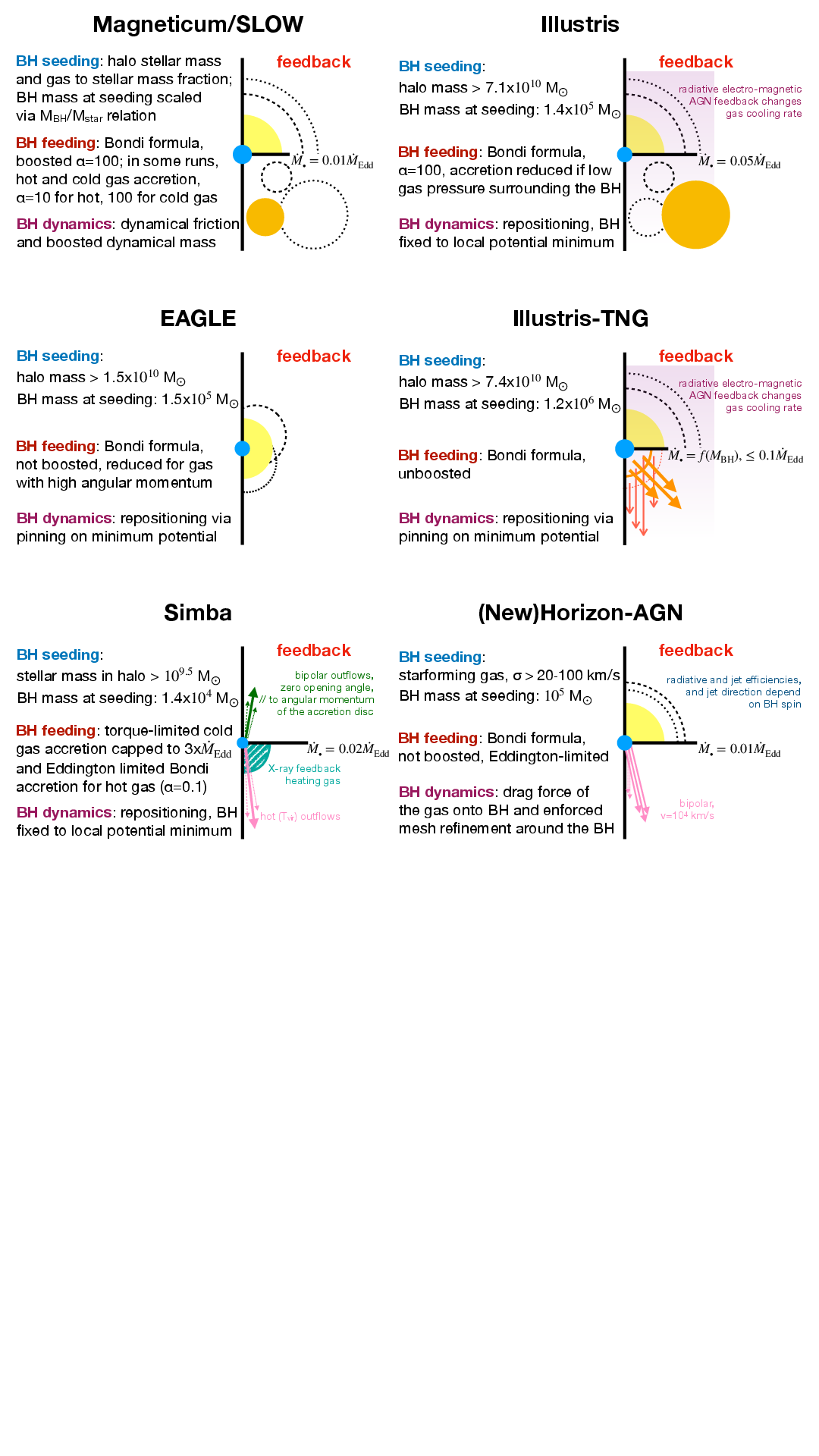
Fig. 12总结了一些现代宇宙学模拟在黑洞增长、AGN供给和反馈建模中所采用的数值方案。上述六个示意图旨在提供对各模型的简化而直观的理解和比较。
Fig. 12 summarises the numerical prescriptions that some modern cosmological simulations adopt to model BH growth, AGN feeding and feedback. The six sketches in the aforementioned figure aim at providing a simplified yet immediate understanding and comparison among the various models.
以下就模拟中AGN反馈建模给出几点评论,涵盖:$(i)$模型参数校准;$(ii)$许多最先进模型背后的简化;以及$(iii)$不同模型之间的比较。
A few remarks on AGN feedback modelling in simulations follow, about: $(i)$ model parameter calibration; $(ii)$ the simplification underlying many of the state-of-the art models; and $(iii)$ comparison among different models.
亚网格物理,特别是模型的自由参数,通常通过调谐来重现观测量。AGN反馈效率(即$\epsilon_{f}$和$\epsilon_{r}$)尤其如此。大多数宇宙学模拟通过尝试重现一系列观测量来校准自由参数(可能在理论、唯象或数据所建议的范围内取值)。最著名的校准对象是黑洞-恒星质量关系([231]
、[238]
)和星系恒星质量函数(GSMF,如[310]
),通常在红移$z=0$处。其他校准目标包括:星系质量-尺寸关系、重子或气体质量份额、金属丰度-质量关系和光度-质量关系。建议读者参阅[226]
以获取更广泛的讨论。模型校准的常见策略包括:对选定数据集进行拟合(如EAGLE)、利用与某些观测比较的趋势(如Magneticum、Illustris)、借助机器学习(如FLAMINGO),或与先前/降尺度版本的类似模拟进行比较。
Subgrid physics and in particular free parameters of the models, are usually tuned to reproduce observables. This is especially true for AGN feedback efficiencies (i.e. $\epsilon_{f}$ and $\epsilon_{r}$).
The majority of cosmological simulations calibrate free parameters (possibly within ranges suggested by theory or phenomenology or data) by attempting to reproduce a number of observables. The most popular examples are the BH to stellar mass relation [231]
,[238]
and the galaxy stellar mass function (GSMF, e.g. [310]
), usually at redshift $z=0$. Other calibration targets include: the galaxy mass-size relation, baryon or gas mass fractions, metallicity-mass and luminosity-mass relations. We refer the reader to [226]
for a more extended discussion.
Common strategies to model calibration consist in performing a fit to selected data sets (e.g. EAGLE), to exploit trends in comparison to some observations (e.g. Magneticum, Illustris), to profit from machine learning (e.g. FLAMINGO) or from comparison to previous/scaled-down versions of similar simulations.
分辨率改变时,也存在不同的处理方法。弱收敛(与强收敛相对,见[41]
)通常是首选,对于不同的数值分辨率,常见做法是至少调整模型参数的若干数值。
There are as well different approaches when resolution changes. Weak convergence (as opposite to strong convergence, see [41]
) is usually preferred, and for different numerical resolutions it is common practice to adapt at least a few values of the model parameters.
然而,用于校准的观测数据集的选择不仅影响参数调谐。更重要的是,由此可理解不同模拟预测在各种观测面前的表现。例如,Magneticum模拟在重现星系团内介质(ICM)和星系群内介质的物理性质方面优于其他模拟(参见[311]
中的一个例子),而Illustris-TNG、Simba和EAGLE等模拟通常在预测星系群最终性质方面更胜一筹。这主要源于校准目标的不同,即Magneticum模拟针对ICM和恒星金属丰度含量加上X射线光度-质量关系,而其他模拟则针对GSMF和星系质量-尺寸关系。
However, the choice of the observational data sets adopted for calibration does not impact parameter tuning only. Rather, it allows to understand the performance of different simulation predictions against various observations.
For instance, the Magneticum simulation succeeds at reproducing the physical properties of the ICM and of the intra-group medium better than other simulations (see [311]
for an example), while simulations like Illustris-TNG, Simba and EAGLE usually outperform the competition as for predicting final properties of the galaxy population. This mainly stems from the calibration targets, i.e. ICM and stellar metallicity content, plus X-ray luminosity-mass relation for the Magneticum simulation versus GSMF and galaxy mass-size in the others.
z = 2
z = 0
在任何亚网格模型背后的众多假设中,其中一个简化是承认:关于AGN反馈能量如何与ISM不同相耦合,我们知之甚少。[270]
研究了将AGN反馈能量分配给ISM各相的重要性。在MUPPI亚分辨率模型([155]
、[135]
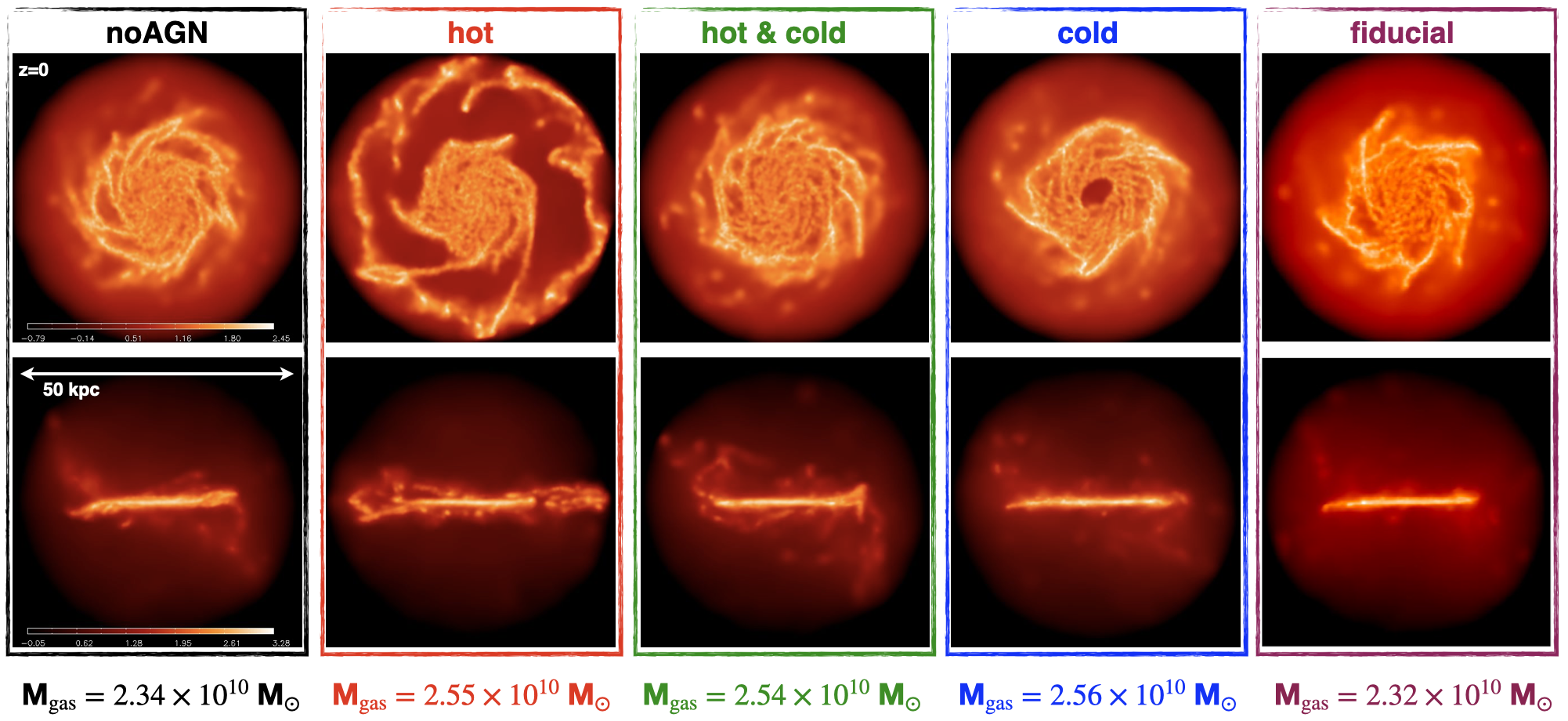
)框架内,他们展示了仅向热气体或冷气体提供反馈能量、向两相均匀分配黑洞反馈能量,以及根据热气体和冷气体的物理性质(即冷云的覆盖因子)耦合AGN反馈能量所带来的影响。他们发现,AGN反馈能量耦合到ISM各相的数值方案会影响最终的黑洞和宿主星系性质(见Fig. 13)。有趣的是,他们假设AGN反馈能量要么用于提高热气体温度,要么用于蒸发分子气体,而不是例如使多相粒子偏离平衡解([241]
)。
Among the many assumptions underlying any sub-grid model, one simplification consists in accepting that little is known about how AGN feedback energy couples with different phases of the ISM.
[270]
investigate how relevant it is to distribute AGN feedback energy to the individual phases of the ISM. Within the MUPPI sub-resolution model [155]
,[135]
, they show the impact of supplying feedback energy to hot or cold gas only, of evenly providing the two phases with BH feedback energy, and of coupling AGN feedback energy to the hot and cold gas according to their physical properties (i.e. the covering factor of cold clouds). They find that the numerical prescriptions adopted to couple AGN feedback energy to the ISM phases affect final BH and host galaxy properties (see Fig. 13). Interestingly, they assume that AGN feedback energy is used either to increase the hot gas temperature, or to evaporate molecular gas, instead of e.g. producing a deviation from the equilibrium solution of multiphase particles [241]
.
最后,评估不同AGN供给和反馈模型之间的差异并非易事。感兴趣的读者可参阅[312]
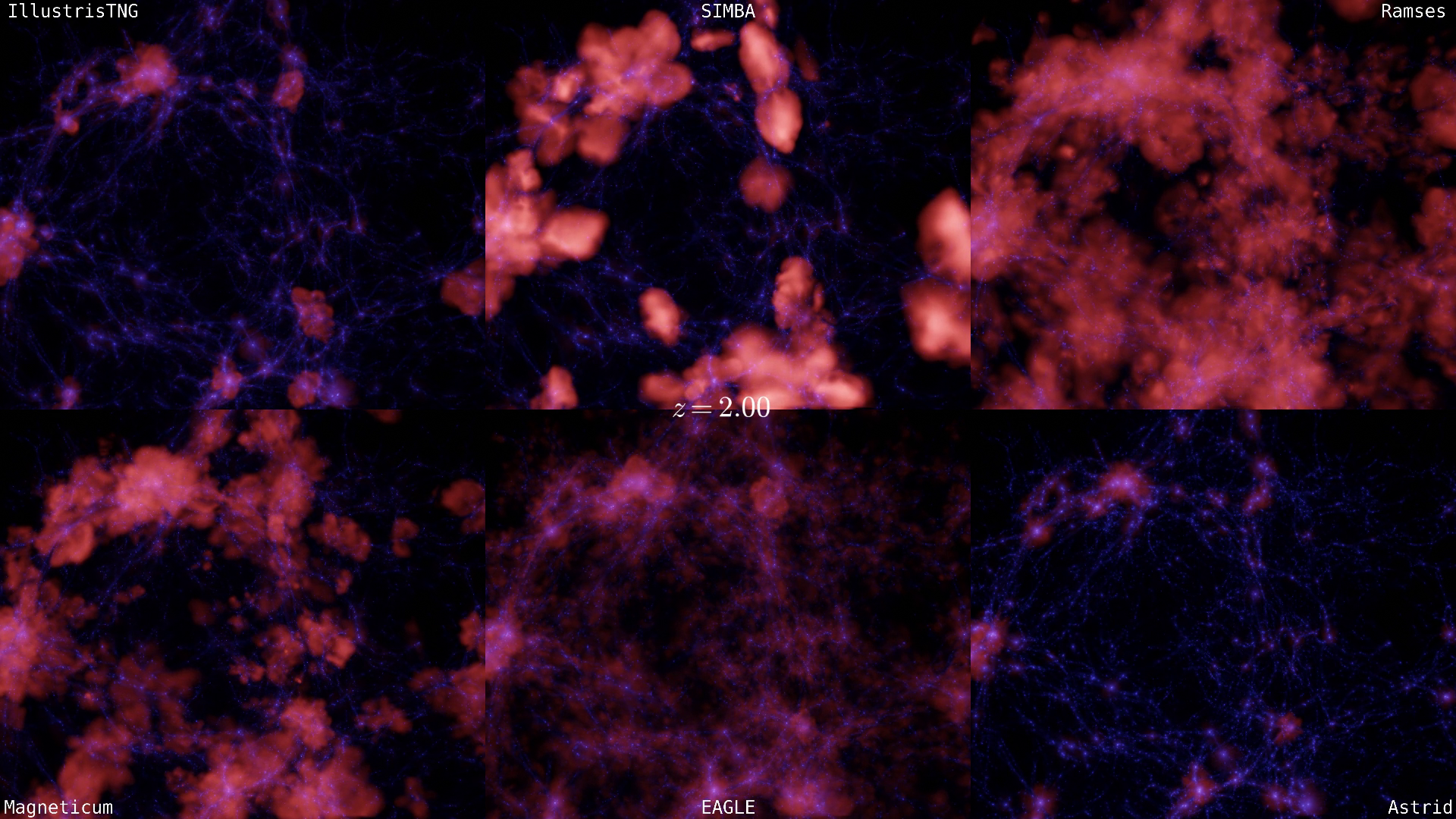
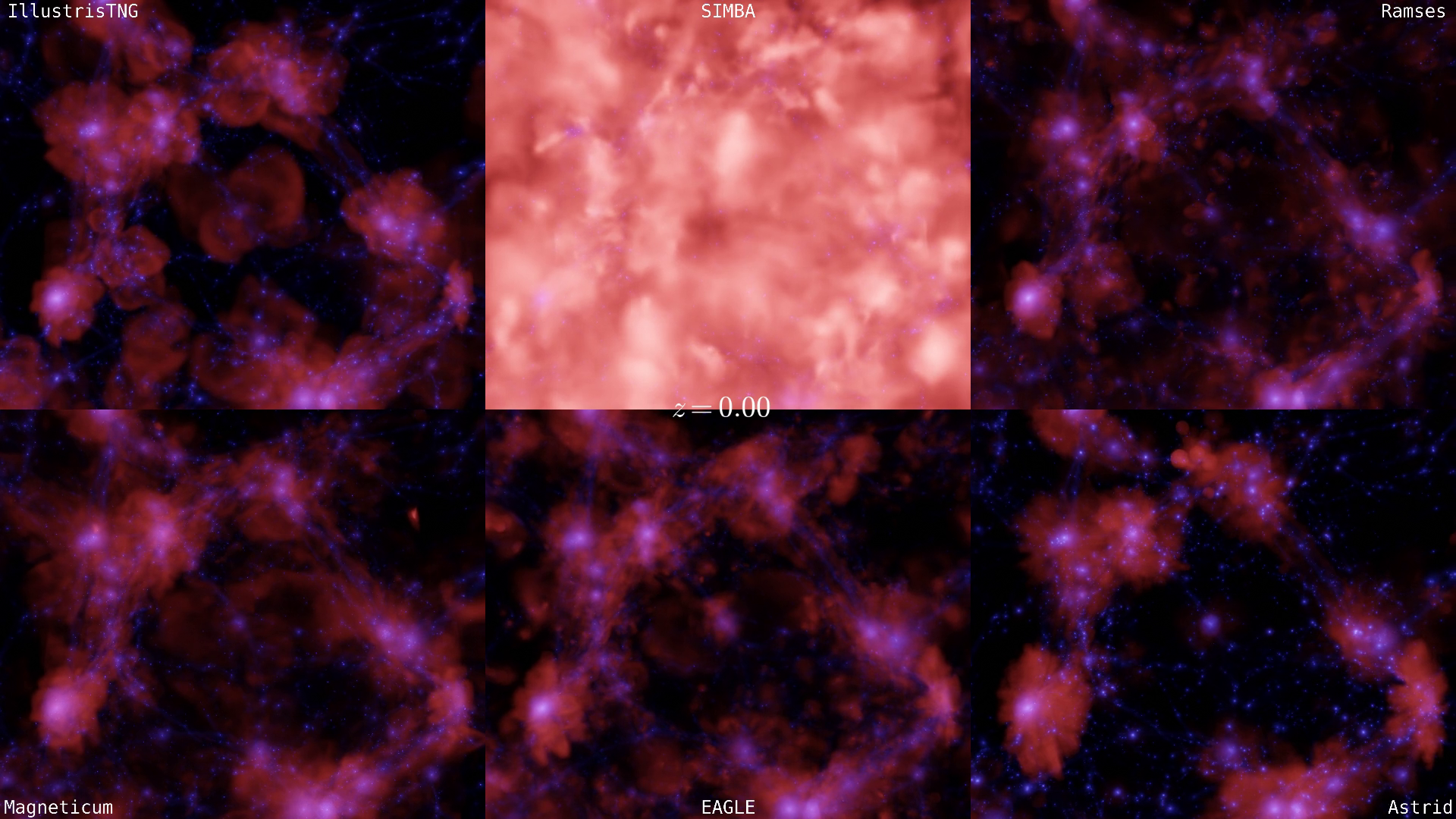
,其中有一项参考性比较研究,探讨了黑洞种子、AGN供给和反馈各种方案的影响。在CAMELS项目([313]
)中,不同的实现方案也在同一宇宙学模拟中进行了测试。此处,Fig. 14(及其关联动画)展示了某些最先进宇宙学模拟中采用的各种亚网格模型,在能量分布和IGM/CGM演化方面所预测的差异。
Finally, assessing the differences among different models for AGN feeding and feedback is not straightforward. We refer the interested reader to [312]
for a reference comparative study where the impact of various prescriptions for BH seeding, AGN feeding and feedback has been addressed. Different implementations are tested with the same cosmological simulation also in the CAMELS project [313]
. Here, Fig. 14 (along with the associated movie) provides evidence of how various sub-grid models adopted in some state-of-the-art cosmological simulations predict differences as for the energy distribution and the evolution of the IGM/CGM.
评论